Rebuilding liquid glass for Flutter
In June 2025, four days after Apple announced Liquid Glass, we published liquid_glass_renderer. Today we're releasing 1.0.0-dev.0, the first preview of 1.0. It's a ground-up rewrite, and as far as we know, the most visually accurate and best-performing implementation in Flutter to date.

In June 2025, four days after Apple announced Liquid Glass, we publishedliquid_glass_renderer. It was one of the very first ways to get the effect
in Flutter: shader-based refraction, edges that catch the light, and shapes
that melt into each other when they get close, all based on widgets you can insert into your tree as you wish. Its ideas spread.liquid_glass_widgets built its rendering pipeline on our code, and the
renderer will soon be integrated into cupertino_ui.
But it never quite looked like Apple's glass. It also had a memory problem:
stretch a button under your finger and memory went up, and resizing a sheet
pushed it higher still. These spikes could get so bad, that the OS would kill your app for memory pressure.
Today we're releasing liquid_glass_renderer 1.0.0-dev.0, the first preview
of 1.0. It's a ground-up rewrite, and as far as we know, the most visually
accurate and best-performing liquid glass implementation in Flutter to date.
As opposed to the previous versions of the package, we are planning to eventually move this out of developer preview. But we need your help testing the package and reporting issues.
Along the way we built three tools: a harness that renders the same scene in SwiftUI
and in Flutter and diffs the two, a benchmark runner that reads a Pixel 10's
power rails, and a tool that predicts Impeller's render passes. This post
covers what those tools taught us. A few of the findings went against what we
expected.
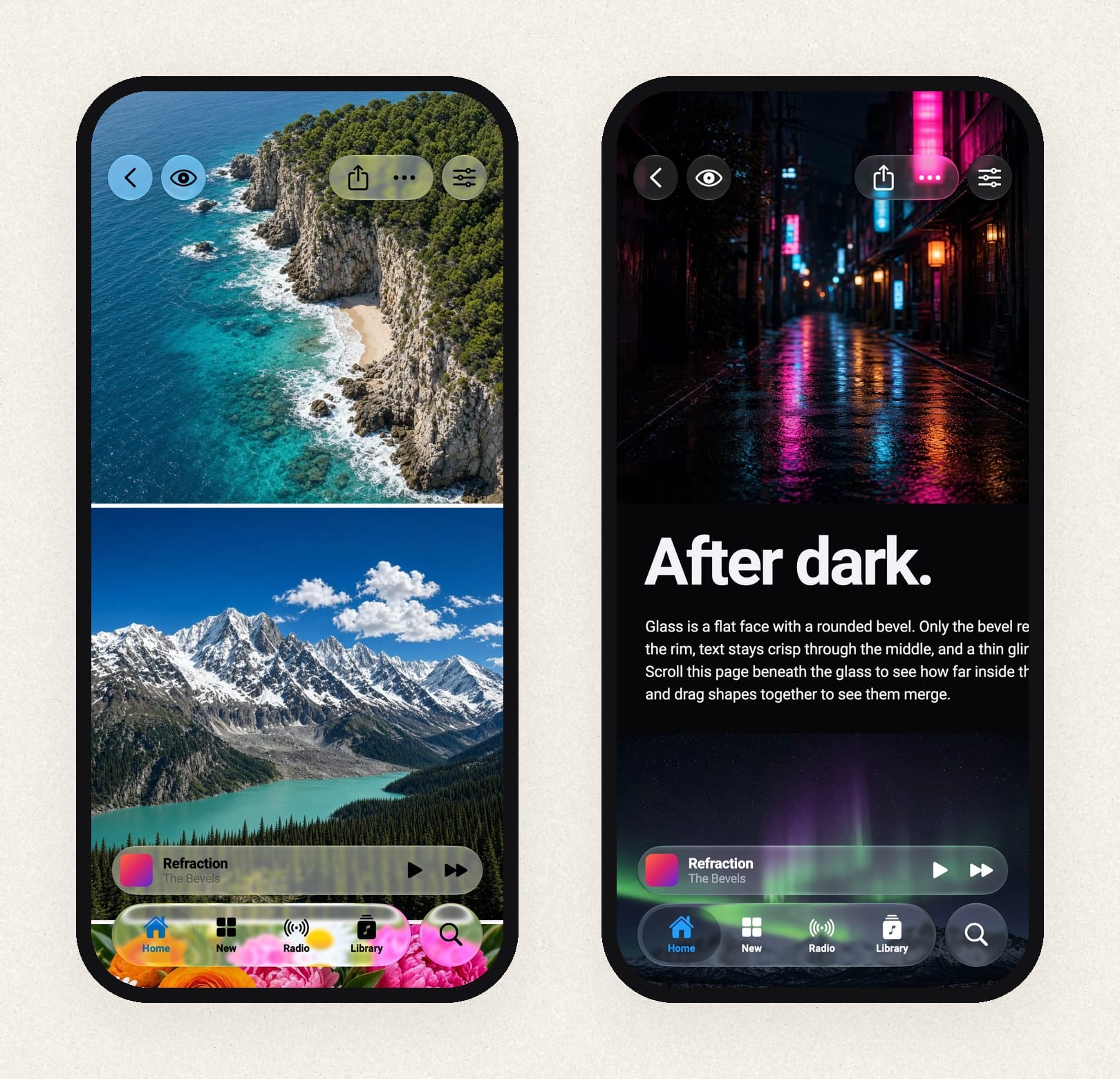
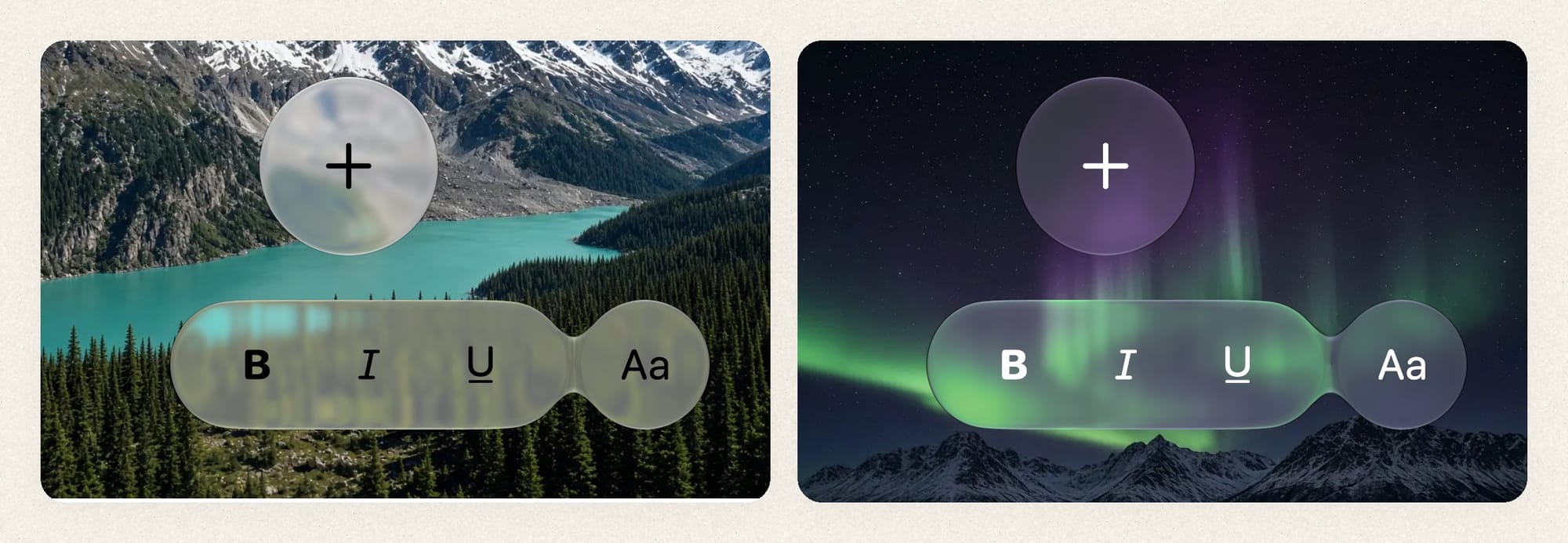
The example app in light and dark mode. Every screenshot in this post is
rendered by Flutter, at iPhone 17 Pro size.
Glass in two halves
Rendering glass involves two kinds of work, and they change at very different
rates.
The first is about the shape. How far is this pixel from the edge? Which
way does the surface tilt here, and how far should the background bend? None
of that changes unless the shape changes or resizes.
The second is about the background. Whatever sits behind the glass has to
be bent, tinted and lit, and that has to happen again every time the content
underneath changes, which during a scroll means every frame.
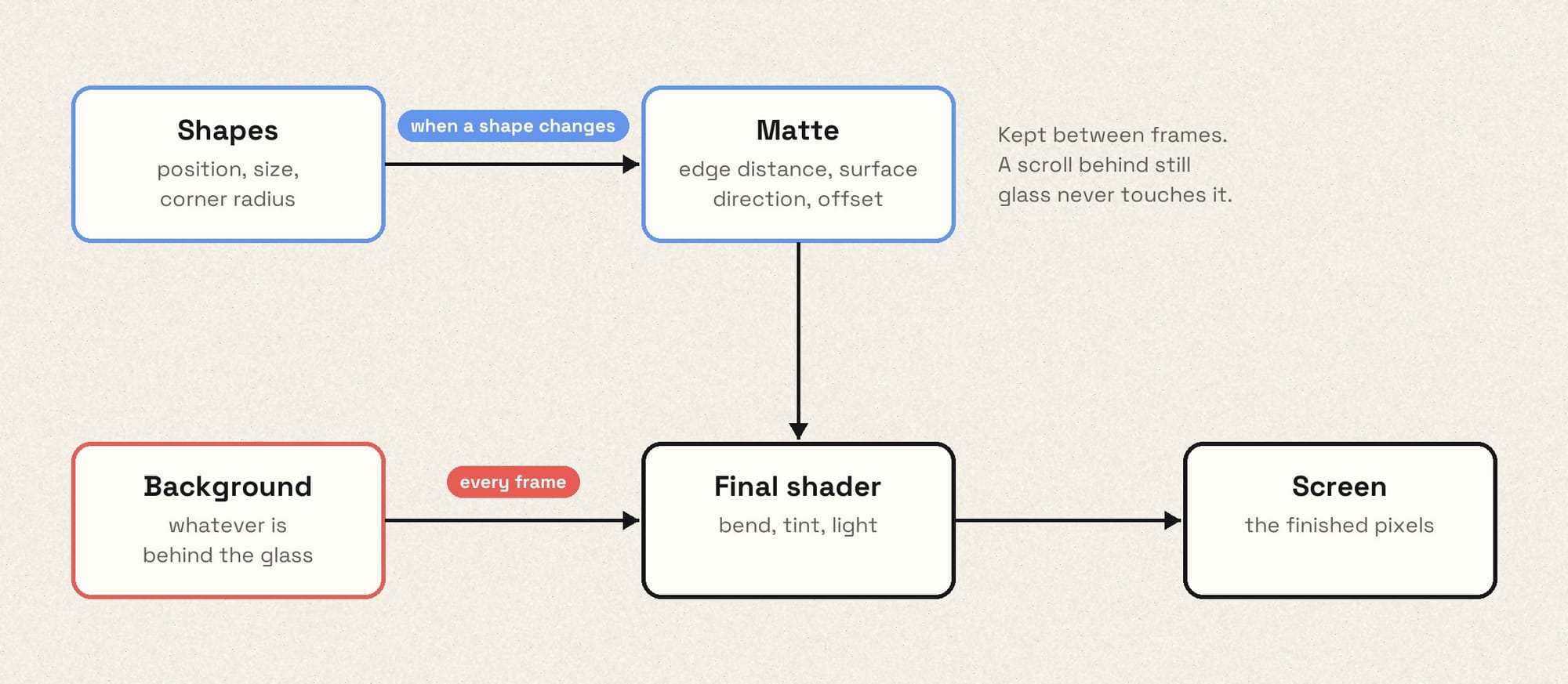
1.0 keeps the two apart. The shape work goes into a small texture we call the
matte, and the renderer keeps it until a shape changes. Every frame, one
final shader reads the matte, samples the background through it, and adds the
rim highlights, the dark outline and the inner shadow. When a list scrolls
behind a tab bar that isn't moving, the shape work doesn't run at all.
32 bits per pixel
The matte is an ordinary RGBA8 texture. That's 32 bits per pixel to describe
the lens at that point, and every one of them gets used.
Here's why precision matters. With 60 points of refraction on a 3× screen, the
background can shift by about 180 physical pixels. Store that offset in 8 bits
and each step is 0.7 pixels, which is coarse enough to show up as stair steps
along the curved edge. So the matte packs a 12-bit surface direction and a
12-bit offset into three channels. The fourth stores the distance to the edge,
on a curve that puts most of its precision right at the edge.
Shapes that get close merge through a smooth union. The blend depends on how
differently the two surfaces face, so neighbours form a clean bridge instead
of swelling into a blob.
The memory bug that wasn't in Dart
The old pipeline recorded the shapes into a picture and rasterized it into a
brand-new image with Picture.toImageSync every time a shape changed. During
a stretch animation, that was one new GPU texture per frame. On the Dart side
everything looked correct, because we dropped each old image as soon as its
replacement arrived.
Dropping the image doesn't free its memory right away, though. The texture
stays alive until the engine is done with it, which can be several frames
later. A sheet-sized matte at 3× is about 8 MB. At 120 frames per second,
those leftover textures add up to hundreds of megabytes while the animation
runs.
Moving to Flutter GPU didn't fix this by itself. A Flutter GPU texture is a
small Dart object wrapping a large native allocation, and the garbage
collector only counts the small object. A matte replaced every frame looks
like a few bytes of garbage to the GC, so it sees no reason to hurry. In one
host test we rendered 1,200 mattes in a row, and 570–700 MB was still
allocated when the loop finished. It was released after a few seconds of
idle time. A phone that's low on memory might kill the app before then.
liquid_glass_widgets, which vendors our old pipeline, handles this by
making the textures smaller. While a large shape animates, it renders the
matte at reduced resolution, capped at about one megapixel. When the
animation ends, it renders one more matte at full resolution. That limits
how big each leftover texture gets, but three problems remain:
- It still allocates a new texture on every frame. The pile of leftover
textures is smaller but still there. Our benchmarks showed the allocation
itself is the expensive part: the UI thread spends milliseconds of every
frame creating and submitting a texture it throws away one frame later. - Low-resolution mattes are wrong at the corners. We tried this
ourselves. The matte's values don't change linearly from one pixel to the
next, so smoothly interpolating a low-resolution matte bends the
refraction exactly where the curvature is highest. - The quality changes when the animation stops. The glass animates at
one resolution and comes to rest at another.
Flutter GPU textures have no dispose(), so we couldn't free them early
either. 1.0 stops creating them instead: each glass layer keeps a small ring
of textures and draws into the same ones over and over, at full resolution.
That took three attempts.
- Plain reuse. On the Pixel this was a clear win. On the Mac it made
memory worse for anything that kept changing size. Retired textures of
every size piled up faster than the GC released them, and one large resize
peaked at 2.4 GB. - Reuse with headroom. We made each texture a bit bigger than needed, so
small size changes would fit without a new one. Some scenes improved. A
full-width sheet resize went from 688 MB to 1,185 MB, because every texture
the ring replaced was now larger. - Grow-only. A texture in the ring never shrinks. It grows in steps of
about 1.5×, and the renderer only draws into the part it needs. A sheet
moving between 45% and 90% of the screen keeps reusing one large texture
instead of allocating dozens of different sizes.
The third design shipped. Compared with creating a new texture on every
change:
| Scene | New texture per change | 1.0 (grow-only reuse) |
|---|---|---|
| Pixel 10, full-width sheet resize: peak memory | 647 MB | 321 MB |
| Pixel 10, full-width sheet resize: frame rate | 93 fps | 108 fps |
| Pixel 10, three stacked glass layers: frame rate | 70 fps | 119 fps |
| Pixel 10, button stretch: UI-thread paint time | 3.7 ms | 0.9 ms |
| M4 Max, large resize: peak memory | 2,119 MB | 610 MB |
How we benchmark
A screenshot can't tell you what an effect costs to run. To compare builds
fairly, we built two benchmark runners.
The Pixel 10 runner installs several builds side by side and alternates
between them, reversing the order each repetition so neither build always
goes first. Before every run it waits until the phone has cooled to a fixed
skin temperature. Each run records a Perfetto trace with power draw in
milliwatts (GPU, CPU and memory, measured separately), GPU cycles per frame,
UI-thread timings and memory use. A second runner on an M4 Max records
frame timings, memory footprint and Metal GPU time. Each benchmark scene
isolates one cost: a button stretch, a sheet resize, sixteen shapes merging,
three stacked layers.
A few things might be surprising here:
- Higher frame rates can raise power draw. With texture reuse, scenes
that used to drop frames hit 120 fps. The phone renders more frames, so
GPU power goes up. The energy per frame went down: 10% less on a button
stretch and 22% less with three stacked layers. Judged on milliwatts alone,
the fix would have looked like a regression. - A small blur can cost more than a medium one. At low sigmas,
Impeller stops downsampling and blurs at full resolution. On the Pixel, a
small blur cost more than a sigma-7 blur. 1.0 handles very light frost
inside the final shader with three texture reads, so it never starts a
separate blur pass. - Shader maths barely mattered. We tried lower precision, fewer
pow
calls and fewer texture reads in the final shader. On the Pixel, power
draw didn't change. Reading back the screen behind the glass is what costs
power: about 115 mW for each separate backdrop filter. - Fake glass isn't free either.
FakeGlassskips the shape work and the
refraction, but it still reads the background and blurs it, and those are
usually the biggest costs. We ran a scripted 54-second session in a real
production app, covering scrolling, tab switching and opening menus. In the
old renderer, fake glass was the most expensive setting. In the rewrite it
draws about a third less power. If you need a fallback that actually saves
battery, use an opaque surface.
Not every result was clear. Metal GPU timings were sometimes too noisy to
show whether a change helped, and the results files report those as
inconclusive.
Matching Apple without fooling ourselves
To check whether our glass looks like Apple's, we compare the two directly.
Each test scene is a JSON file that describes the canvas, the glass shapes
and a set of backgrounds. A small SwiftUI app renders the scene with Apple's
public glass APIs (.buttonStyle(.glass) and GlassEffectContainer) on a
fixed iOS 27 simulator. It saves the median of three settled frames, together
with the OS version, appearance and accessibility settings. A Flutter app
renders the same JSON, and a set of Python scripts compares the two images.
Every scene is rendered over four backgrounds. Each background isolates
different parts of the effect:
- a colour grid shows how the glass bends lines and shifts colour;
- a second grid checks that a fit still holds on a different pattern;
- pure black leaves only the glints and the glow from the surface;
- pure white leaves only the outline, the inner shadow and the drop
shadow.
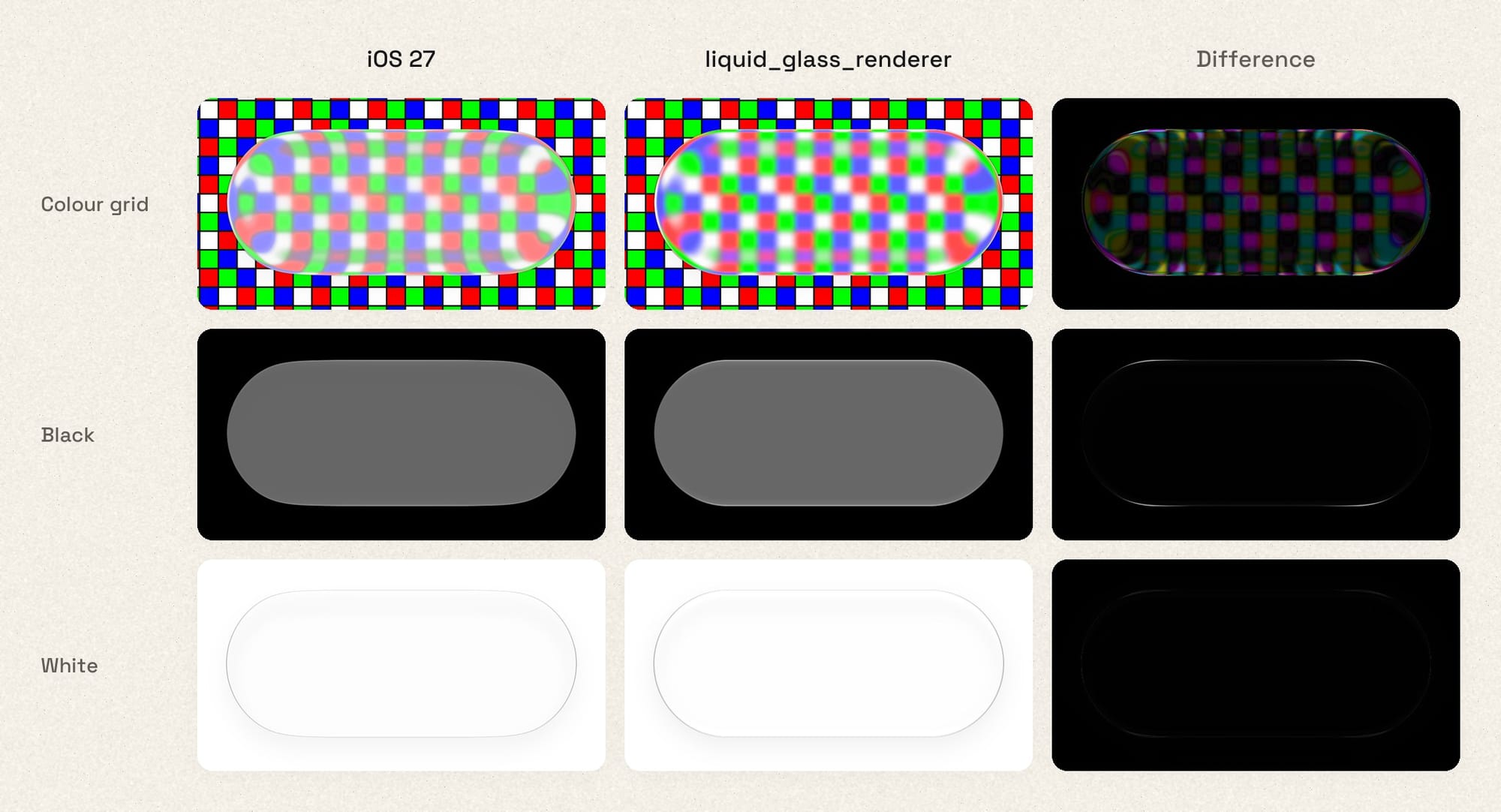
An iOS 27 toolbar button and ours, over three of the four backgrounds. The
right column is the plain pixel difference: black where the two match,
brighter where they don't. Nothing was aligned or colour-corrected. Over
black and white only a faint line along the rim remains. Over the colour
grid the difference shows across the whole face. Most of that comes from how
the two blur the background, explained below. But some color transfer differences still remain for now, which we hope to iron out before 1.0.0.
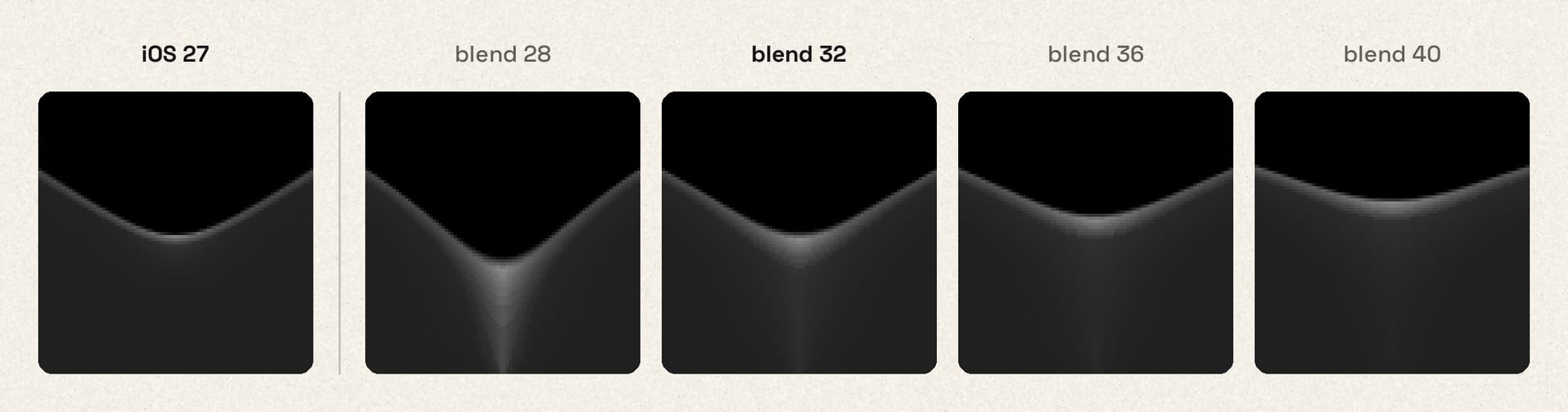
The neck between two merging rectangles, over black. iOS 27 on the left,
then ours at blend radii from 28 to 40. At 32 the bridge has the same shape;
at Apple's own value of 40 it's far too thick.
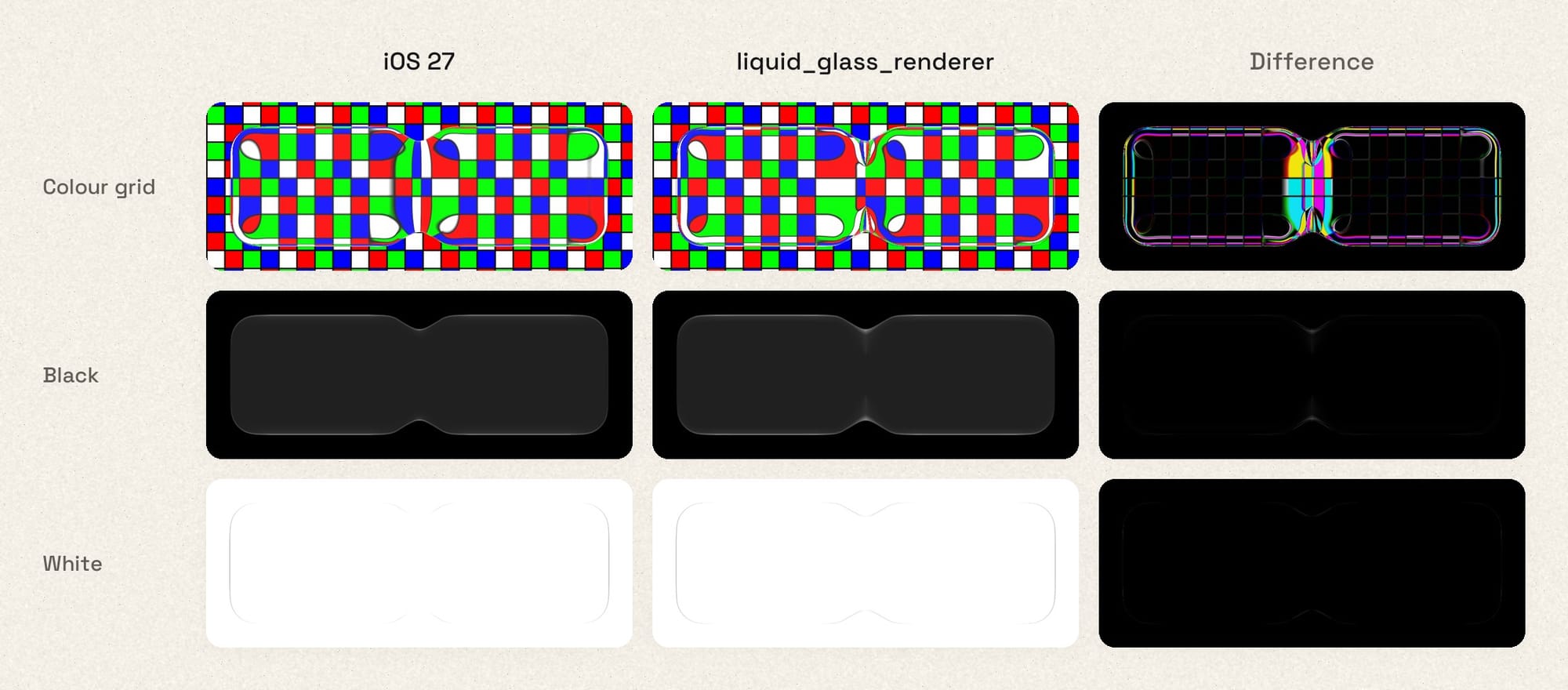
The full comparison at blend radius 32. Over black and white the two are
nearly indistinguishable. The colour grid shows where we still differ: the
glint in the neck and the way the grid bends inside it.
We don't publish an "Apple accuracy" percentage, because the pipeline can't
produce a meaningful one. It's a regression tool. It shows whether a change
moved us closer to Apple's rendering or further away, and in which part of
the image. The captures are SDR, so they don't show HDR. On a real iPhone,
the glint along the rim is brighter than SDR white, and we've verified that
ours reaches the same HDR range there. On Android it can't: Flutter renders
into 8-bit surfaces, so the glint stays within SDR.
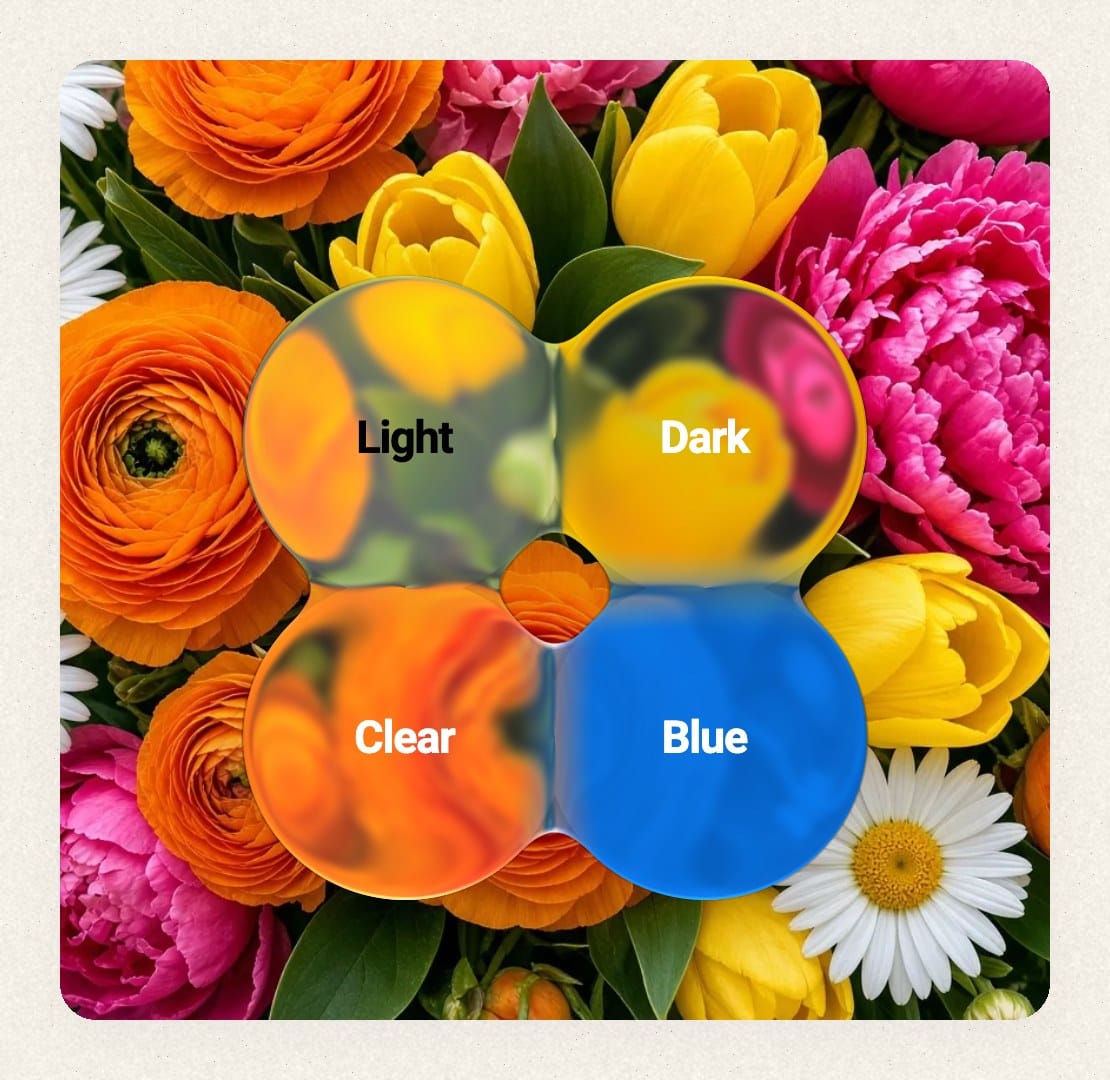
Four appearances in one layer. The light, dark, clear and tinted presets
came out of this tuning work. They're starting points, and you can adjust
them from Dart.
Render passes cost more than the shader
Much of what glass costs on the GPU happens outside the glass shader. On
Impeller, every backdrop filter ends the current render pass, reads back
everything drawn so far, and starts a new pass. A blur adds passes of its
own. A CPU profiler won't show this, and neither will the widget tree.
To measure it, we built impeeler, a small dev tool that records what
Flutter draws and replays Impeller's decisions about where to split render
passes. For each frame it reports how many passes there are, how large they
are, and which widgets caused them. It predicts rather than profiles, but on
14 test scenes its predictions matched real GPU traces on both Metal and the
Pixel.
Two patterns in 1.0 come from those measurements:
- Share the background where possible. All glass shapes in one layer
sample a single shared copy of the background. In the test scene above,
two blurs sharing one background needed half as many passes as two
separate blurs. - Capture once when glass sits on glass. A tab bar's selection indicator
has to refract the bar beneath it, so it can't use the same background copy
as the bar.LiquidGlassCapturereads the screen once into a small, tightly
cropped area. The bar draws inside it first, then the indicator, which sees
the finished bar. This only helps when the effects are small and close
together. A fullscreen layer gains nothing.
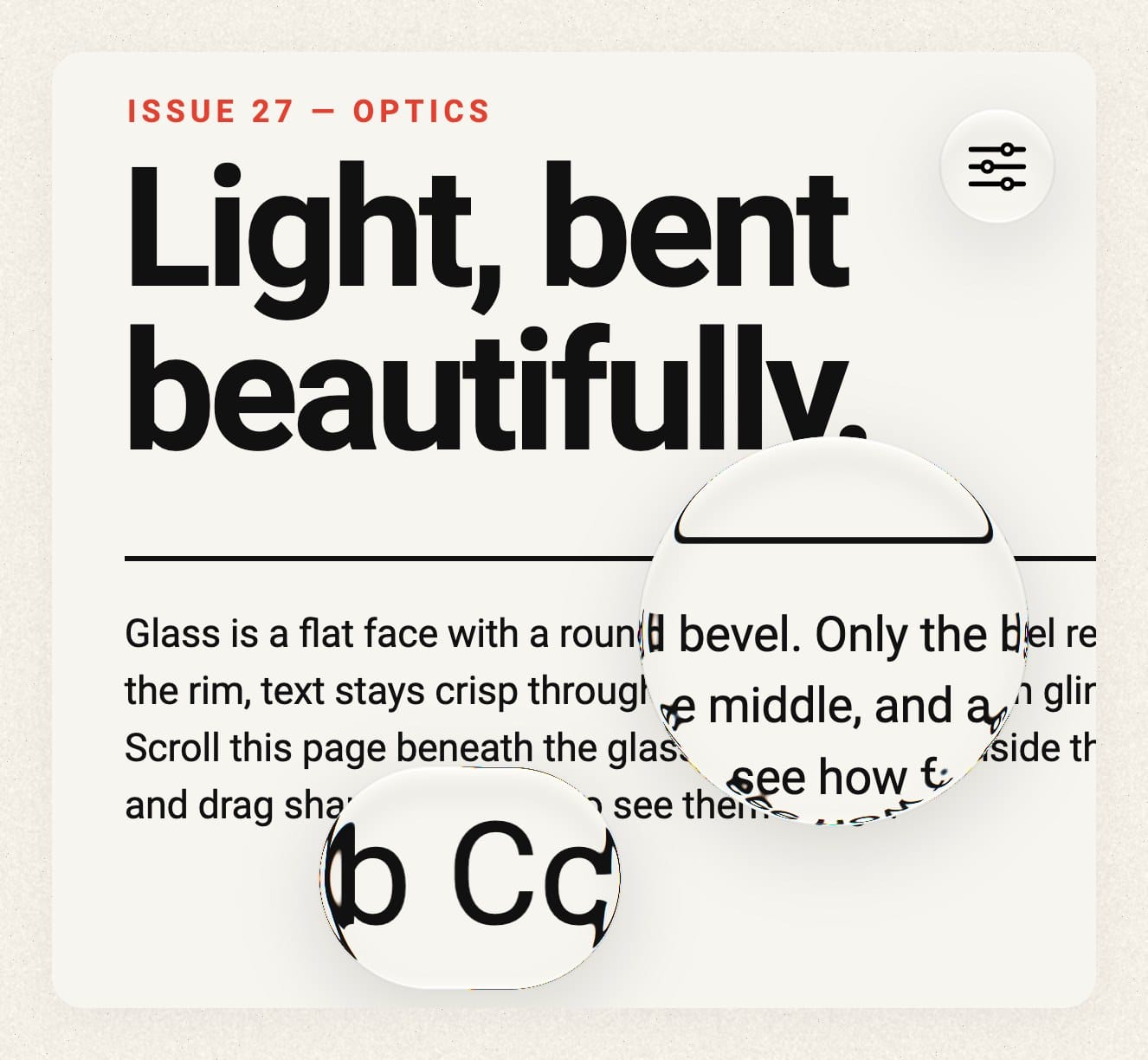
The text-selection loupe and a round magnifier, both magnifying the live
content underneath.
What changes for you
1.0 is a breaking release. Glassify, arbitrary shapes and child refraction
are gone. The supported shapes are circles, ovals, rounded rectangles and
rounded superellipses, with up to 16 per layer. Children are drawn sharp on
top of the glass instead of being refracted through it. The full effect
needs Flutter 3.47 with Impeller and uses flutter_gpu, which is still a
preview API. Skia and web builds fall back to FakeGlass. The license
changed from MIT to Apache 2.0.
What's next
Animating glass no longer uses extra memory. Composition costs are
predictable, and we can measure how far our rendering is from iOS.
That measurement shows work still to do. In the comparison images, the
refraction, color transfer, the rims and the glint where shapes merge all still differ from
Apple's. Our memory numbers come from
one Pixel and one Mac, so measure GPU time and battery on the devices your
app targets.
1.0.0-dev.0 is a preview, and the API can still change before 1.0. Try it in
your app and tell us what breaks. The scenes, capture scripts and benchmark
runners are all in the repository. If our glass looks clearly wrong in some
situation, the most useful bug report is a scene file that reproduces it.